The Identity You Didn't Choose
Who do you believe yourself to be?
Not what you do for work. Not your title. Not your roles as mom, partner, daughter, leader.
Who. Do you. Believe. You are?
I asked a room full of women that question recently at a Golden Hour — Alma's monthly community gathering — and you could feel the air change. Not because it was a hard question. Because it was a question most of us had never actually stopped to answer.
Here's what I've come to understand:
“Who we believe we are shapes what we believe is possible.”
And a lot of us are walking around with an answer to that question that we didn't consciously choose.
The chicken coop
I grew up in the Twin Cities metro. Houses close enough to touch. Streets. Sidewalks. No farm anywhere in sight.
And then my mom married my stepdad — and suddenly I had this whole new world. New aunts and uncles and cousins, all up north. One of them, my Aunt Sherry, had a farm. Goats. Ducks. Chickens. Cows. All of it.
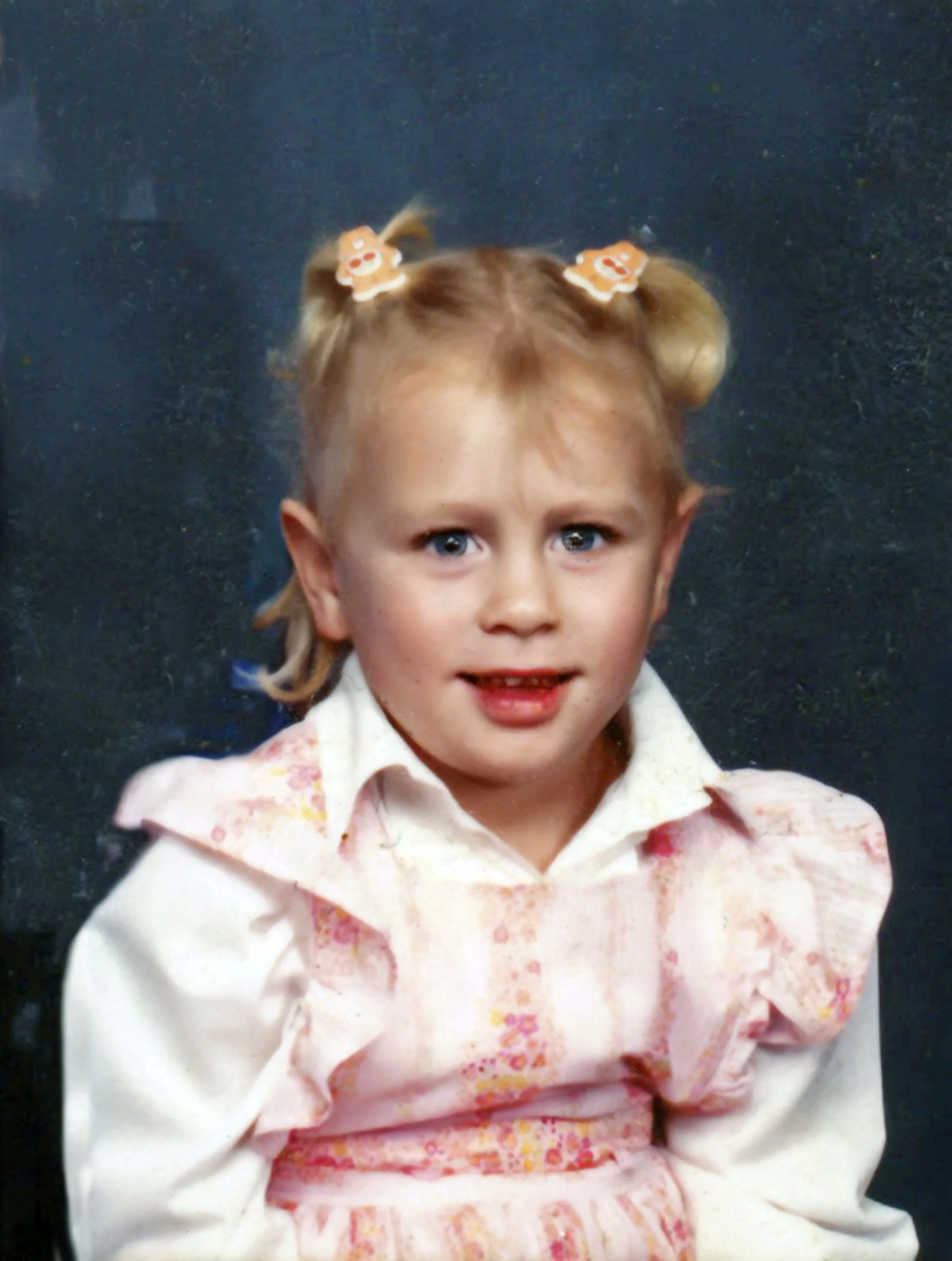
I was fascinated. Endlessly curious little Kristi — the one who asked questions about everything, all the time, about everything.
So one weekend we visited, and I was running around with my older boy cousins. Bigger, louder, not exactly my people. But I wanted in. I wanted to know everything about that farm.
They said: "Want to see the chicken coop?"
Obviously. Yes.
This wasn't a little box. It was a walk-in chicken coop — chickens lined up on both sides, chickens absolutely everywhere. We walk in. I'm asking all the questions.
At some point I turn around.
The boys are gone.
I go to leave. The door is latched. They locked me in the chicken coop!
I don't know how long I was in there. Everyone in my family still gives you a different number. Five minutes? Five hours? Somewhere in between.
But here's what I know for certain. While I was standing in that chicken coop, something happened deep in my subconscious.
They called me Yakety Yak.
And somewhere in that moment, an identity was born:
I talk too much.
I ask too many questions.
People get tired of me.
I am too much.
It doesn't require a big moment
I want to be really clear about something.
These were not important people in my life. They were kids I barely knew. And logically, I can look back now and see exactly what it was — obnoxious preteens doing obnoxious preteen things.
But that's the thing about identity formation.
“It doesn’t require importance. It doesn’t require a massive event. Sometimes it’s a passing comment. A joke. A look. A moment that meant absolutely nothing to the person delivering it — and everything to us.”
The chicken coop became family legend. We'd tease the boys about it. I thought I had moved on.
But I hadn't.
Because that super talkative little girl? She just stopped coming out.
I started hearing myself say things like: Get to the point, Kristi. You're going on too long. They don't want all of this.
Some of those adaptations served me. I became an efficient communicator. A tight facilitator. Someone who could cut to the core quickly.
But it also made me a reluctant speaker. Every time I was on a stage, even when I knew the material like the back of my hand — even when people kept inviting me back — there was still a part of me trying to take up as little space as possible.
It wasn't until about a year ago that I finally stopped and asked: Where did this come from?
And when I traced it back — when I actually looked for the evidence — the evidence was three boys. At a farm. Forty years ago.
That was the entire case.
My three obnoxious cousins somehow became the authority on whether people wanted to hear me talk.
Why identity sits above everything else
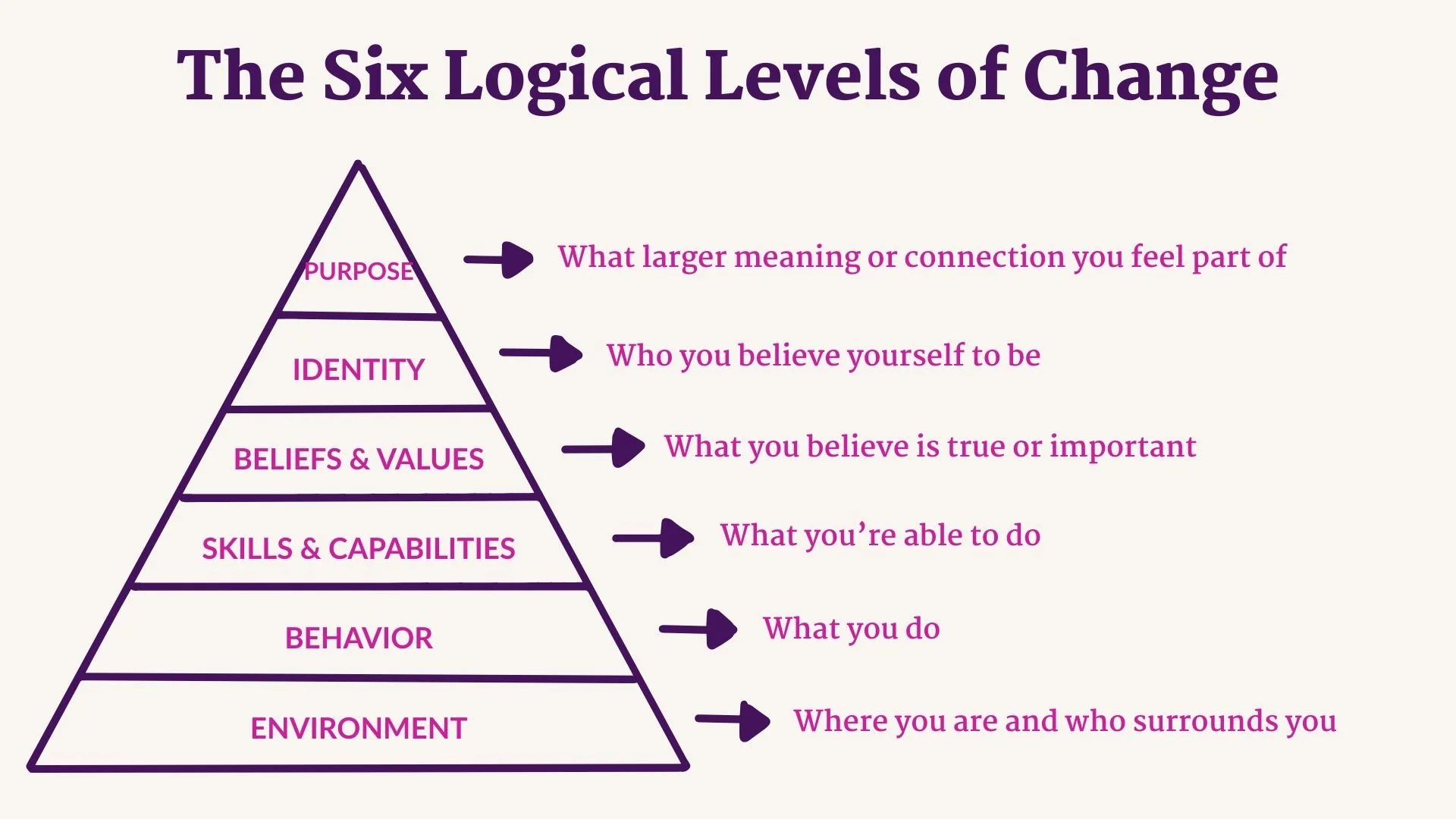
In NLP — Neuro-Linguistic Programming — there's a framework called the Logical Levels of Change.
The idea is that change happens at different levels, and the deeper the level, the more lasting the impact.
At the bottom: your environment. Above that: your behavior. Then your skills. Then your beliefs and values. Then identity — who you believe yourself to be. And at the top: purpose.
Here's why this matters for high-achieving women in particular.
Most of us try to change behavior without ever touching identity. We say: I want to speak up more. I want to lead more confidently. I want to stop second-guessing myself.
But underneath those goals, if there's an identity running quietly in the background — I'm too much, I'm not someone people listen to, I've never really been a leader — then behavior change becomes exhausting. You're fighting yourself the whole way.
When you shift the identity first, the behavior starts to follow naturally.
A tool to start investigating
At Golden Hour, I shared a framework I've been using called the Identity Inquiry Framework. Here's how it works:
Start by naming an identity you've been carrying. Maybe it's one of these: The Responsible One. The Shy One. The Fixer. The Achiever. The Difficult One. Or maybe yours is more specific — something someone said once that got in.
Then ask:
Where might it have come from? A specific moment, a relationship, repeated messaging, cultural expectations.
What evidence actually supports it? Concrete evidence only.
What evidence contradicts it? This is the important one.
What identity feels more aligned with who I'm becoming?
That last question is not about toxic positivity or affirmations disconnected from reality. It's about finding the evolved version — the one that's actually true.
For me, the answer was: I'm a connector. That's my real identity. I love to learn about people. I love to share stories as a way to build bridges. And the people who know me well would probably say: yeah, Kristi. That tracks.
The only question worth sitting with
Identities are interpretations, not objective truth. They were formed from moments, experiences, and stories — and if an identity was learned, it can also evolve.
You don't have to erase every identity you've ever carried. Some of them protected you. Some helped you survive. Some helped you get here.
But it's worth asking:
“Does this identity still serve who I’m becoming?”
If you want to explore this further, our next Golden Hour is August 6th. Details at almaleaders.org.